



Market Dislocation Breeds Generational Opportunity
- We firmly believe this swift reset in fixed income valuations has created an extraordinary, and generational buying opportunity for long-term investors.
- The sudden shift in price has pushed tax-exempt nominal yields to levels that are among the highest observed in close to twenty years.
- Depending on an investor’s specific state of residence, individuals can now capture equity-like taxable equivalent yields (TEYs) approaching or exceeding 10% in municipal bonds.
- For the discerning wealth manager and high-net-worth investor, market dislocations should be viewed not as a risk to be feared, but as an attractive entry point to be exploited.
- In high-tax states such as New York and California, where local tax brackets exceed 10% to 13%, the combined marginal tax rate approaches or exceeds 50%. In these specific jurisdictions, the TEY on a high-grade municipal portfolio yielding 5% can safely approach or exceed 10%.
- To put this in perspective, an investor can potentially capture a highly predictable, double-digit tax-adjusted yield, backed by sectors such as essential public infrastructure, devoid of corporate execution risks, earnings vagaries, and equity market volatility that have historically characterized the corporate landscape.
- An opportunity to lock in historically elevated yields now exists.
The third quarter proved to be a critical turning point for fixed-income markets, characterized by a dramatic macro-driven repricing that completely erased the steady gains achieved during the first half of the year. While tax-exempt yields drifted modestly higher throughout July and August, in tandem with a broader global selloff in fixed income, the narrative shifted aggressively in September. The primary catalyst for this upward pressure on municipal interest rates was a sharp, unrelenting surge in U.S. Treasury bond yields. This dynamic shift was driven almost entirely by a significant spike in global oil prices, which renewed inflation anxieties and upended the Federal Reserve’s projected path of monetary policy. The linkage between energy markets and fixed-income assets was undeniable, as evidenced by an extraordinary, near perfect correlation between crude oil prices and benchmark interest rates over the 90-day period ending September 30.
As Treasury yields broke through key technical resistance levels, the municipal market faced severe crosscurrents. The sudden drop in bond prices triggered extensive industry-wide selling, mutual fund outflows, and a mismatch between secondary market supply and institutional demand. This technical pressure, exacerbated by seasonal crosscurrents and proactive tax-loss harvesting, culminated in September recording its worst monthly total return for the municipal bond market since the global financial crisis of 2008.
Understandably, short-term price volatility is unsettling for investors and asset allocators. However, Clinton Investment Management views this dislocation through a highly optimistic lens. We firmly believe this swift reset in fixed income valuations has created an extraordinary, and generational buying opportunity for long-term investors. The sudden shift in price has pushed tax-exempt nominal yields to levels that are among the highest observed in close to twenty years1. For individuals positioned in the highest marginal tax brackets, the structural advantages of tax-exempt cash flow have rarely been more compelling. Depending on an investor’s specific state of residence, wealthy individuals in the highest tax brackets, can now capture equity-like taxable equivalent yields (TEYs) approaching or exceeding 10% in municipal bonds.2
As we look toward the remainder of the year, our outlook on the asset class is supported by strong structural fundamentals. We are of the view that underlying municipal credit quality remains remarkably solid and stable. State and local governments continue to maintain near-record rainy-day funds and robust cash balances, shielding them effectively from a cooling domestic economy. This underlying fundamental strength gives us deep confidence that investors can seek to lock in what are some of the highest tax-free yields in a generation, toward the goal of securing predictable income streams, while awaiting the resolution of the current geopolitical and macroeconomic uncertainties.
The September Energy Shock and Technical Reset
To fully comprehend the magnitude of the third-quarter market adjustment, one must analyze the unique relationship between commodity price inflation and fixed-income mechanics that defined the late summer. The quarter began with a relatively stable backdrop; July and August experienced typical summer technical patterns, characterized by a predictable reinvestment wave driven by seasonal coupon payments and principal maturities. However, underlying vulnerabilities were quietly building as core economic data remained stickier than market participants anticipated.
The true inflection point arrived in September, a month that will be remembered for its severe asset correlation and technical breakdown. The primary transmission mechanism was the energy sector. A rapid reduction in global crude supply, combined with resilient industrial demand, sent oil prices climbing. This energy shock immediately altered inflation expectations, forcing fixed-income investors to price in a “higher-for-longer” monetary regime.
The mathematical precision of this relationship was remarkable. Over the 90 days ending September 30, the correlation between crude oil and long-term Treasury yields rose to over 90%. This tight linkage meant that every incremental dollar increase in oil prices exerted upward pressure on interest rates. Municipal bonds, despite their tax-exempt status and distinct investor base, could not decouple from the broader Treasury selloff.
As benchmark yields surged, the municipal marketplace experienced a severe technical liquidation. Fixed-income mutual funds, including ETF’s, which had enjoyed steady inflows earlier in the year, faced sudden redemption pressures as retail investors reacted to declining net asset values (NAVs). To meet these redemptions, fund managers were forced to sell high-quality, liquid municipal positions into a market of disinclined buyers, putting ever increasing downward pressure on prices. This structural mismatch between eager sellers and hesitant buyers caused municipal yields to spike. When the dust settled, September registered a historic decline, marking the most painful monthly total return for tax-exempt investors since the depths of the 2008 financial crisis.
Taxable Equivalent Yields at Historical Extremes
For the discerning wealth manager and high-net-worth investor, market dislocations should be viewed not as a risk to be feared, but as an attractive entry point to be exploited. Fixed-income dynamics dictate that when nominal yields rise, the compounding value of tax-exemption expands for those in the highest tax brackets. We are currently witnessing an environment where the math heavily favors the tax-exempt allocator over almost every other credit asset class. See Figure 1 below3.
Figure 1.
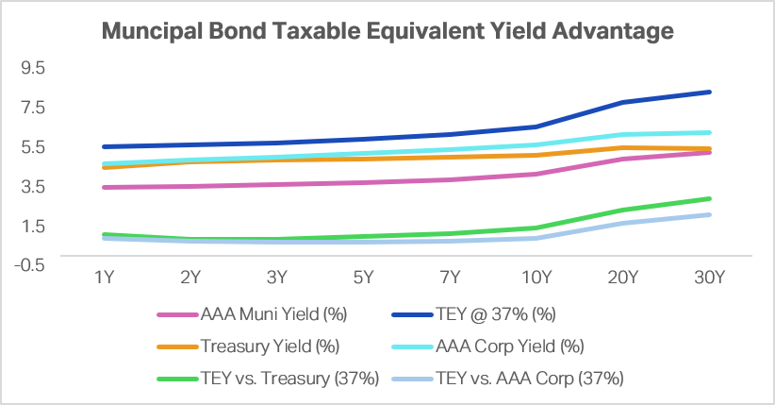
Consider the landscape of fixed income over the past two decades. For much of the post-2008 era, investors were forced to accept sub-2% nominal yields, compressing after-tax returns, and pushing individuals into riskier asset classes to meet their income requirements. Today, the landscape is entirely inverted. Nominal high-grade municipal bond yields across the intermediate and long portions of the yield curve have reached heights not seen since the early 2000s.
When these nominal yields are converted to a TEY, reflecting the true gross return that tax-free munis offer, when compared to taxable alternatives, the results are compelling. For an investor subject to the top federal bracket of 37% plus the 3.8% Net Investment Income Tax (NIIT), a 5.0% nominal tax-exempt yield transforms into an effective taxable return of roughly 8.44%4. When state and local taxes are layered into the equation, the value proposition becomes enhanced. In high-tax states such as New York and California, where local tax brackets exceed 10% to 13%, the combined marginal tax rate approaches or exceeds 50%. In these specific jurisdictions, the TEY on a high-grade municipal portfolio yielding 5% can safely approach or exceed 10%.2
To put this in perspective, investors have the opportunity to capture a highly predictable, double-digit tax-adjusted yield, backed by sectors such as essential public infrastructure, devoid of corporate execution risks, earnings vagaries, and equity market volatility that have historically characterized the corporate landscape.
Municipal Bond Credit Fundamentals Remain Solid
A vital component of our investment thesis is the stark divergence between market price volatility and underlying credit strength. While bond prices fluctuated wildly during the third quarter, the creditworthiness of municipal issuers remained stable. This fundamental divergence creates a stable foundation on which investors can allocate capital and build upon generational high cash flow, without taking on existential credit risk.
Following years of robust tax collections, federal pandemic stimulus distributions, and often conservative budgetary management, state and local governments entered this period of volatility with balance sheets that are among the strongest in modern history. Rainy-day funds across the nation remain near all-time highs and issuers have used the inflationary environment to their advantage, as rising nominal economic activity naturally bolsters sales tax collections and property tax assessments, providing an organic hedge against their own rising operational costs.
Moreover, the structural nature of municipal debt possesses inherent safeguards. Unlike corporate issuers that frequently rely on short-term commercial paper or face constant debt rollover risk in volatile credit markets, the vast majority of municipal debt is structured as long-term, fixed-rate amortization, according to the Tax Policy Center.
Consequently, local governments are not as exposed to sudden spikes in their interest expense profiles; their debt service costs remain locked in at historical levels, preserving cash flow for essential operations and debt repayment. Historical default data from rating agencies consistently reinforce this reality, showing that investment-grade municipal defaults remain an exceedingly rare anomaly, keeping the asset class structurally sound5.
Locking in Yield Amid Macro Headwinds
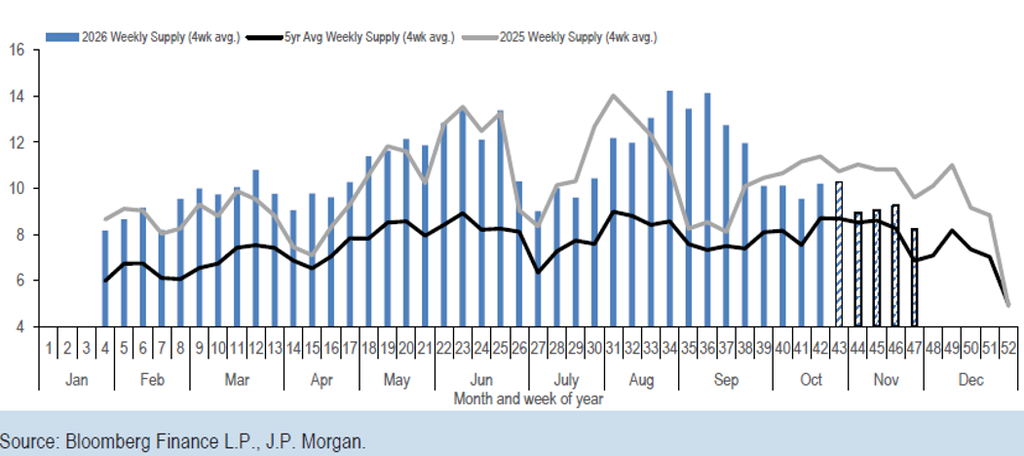
As we look toward the final months of the year, Clinton Investment Management maintains a highly constructive and offensive posture. The overarching macroeconomic backdrop remains clouded by significant crosscurrents, including lingering inflation doubts, evolving monetary policies, and intensifying global geopolitical tensions. However, it is precisely this uncertain backdrop that validates our strategic focus on high-quality, tax-exempt fixed income. Additionally, we expect supply to abate as we approach year-end as evidenced by the recent new issue projections shown in Figure 2 below.
Figure 2.
Our investment strategy, under current market conditions, is straightforward: lock in historically elevated yields now. Waiting for the absolute peak of an interest rate cycle is a notoriously difficult timing exercise that often results in missed opportunities. In our view, present yield levels offer a highly attractive entry point that provides an asymmetric payoff profile. If interest rates remain elevated, investors will continue to compound tax-free income at a rate that handily outpaces inflation. Conversely, if economic growth slows, and inflation cools, leading to a decline in interest rates, investors could enjoy meaningful capital appreciation across the municipal curve.
We expect the technical selling pressures observed in September will naturally subside as tax-loss harvesting programs conclude and institutional buyers step back in to capture market opportunities similar to what we are seeing. Given reduced supply expectations for the fourth quarter, any normalization in retail investor demand could trigger a rapid compression in yield/spreads, causing bond prices to recover just as quickly as they fell.
In conclusion, the third quarter delivered a stark reminder of how macro forces can disrupt short-term asset pricing. Yet, for the forward-thinking, long-term investor, it has reopened a window of opportunity that many believed was permanently closed. By focusing on the solid fundamental credit quality of the municipal market and capitalizing on the historically elevated TEYs available today, investors can confidently position themselves to navigate broader market volatility, secure their financial foundations, and capture the generational high in tax-free income streams municipal bonds now offer, which could serve them well into the future.
Important Disclosure Information
This material has been provided for informational purposes only and is not intended by Clinton Investment Management to provide and should not be relied on for tax, legal or accounting advice. If such advice is required, please consult with your own tax, legal and accounting advisors.
Investing involves risk including possible loss of principal. Municipal bonds are subject to interest rate, credit, and market risk. Bond prices generally fall when interest rates rise. While municipal bond interest is generally exempt from federal income tax and, in some cases, state income tax, capital gains are taxable and certain income may be subject to the Alternative Minimum Tax (AMT).
Please remember that past performance may not be indicative of future results. Different types of investments involve varying degrees of risk, and there can be no assurance that the future performance of any specific investment, investment strategy, or product, made reference to directly or indirectly in this newsletter (article), will be profitable, equal any corresponding indicated historical performance level(s), or be suitable for your portfolio. Due to various factors, including changing market conditions, the content may no longer be reflective of current opinions or positions. Moreover, you should not assume that any discussion or information contained in this newsletter (article) serves as the receipt of, or as a substitute for, personalized investment advice from Clinton Investment Management, LLC. To the extent that a reader has any questions regarding the applicability of any specific issue discussed above to his/her individual situation, he/she is encouraged to consult with the professional advisor of his/her choosing. Please consult with an investment professional before making any investment using content or implied content from any investment manager. A copy of our current written disclosure statement discussing our advisory services and fees is available upon request.
The views and opinions expressed are not necessarily those of the distributing firm or any affiliates. Nothing discussed or suggested should be construed as permission to supersede or circumvent your firm’s policies, procedures, rules, and guidelines.
1JP Morgan Private Bank U.S., “Digging into the rare opportunity in muni bonds today,” 10/19/2026.
2CIM’s current Market Duration (NY Only) sample portfolio, as of October 20th, 2026, reflects a yield to worst of 4.48% which results in a tax equivalent yield (TEY) of 10.09% for a New York City resident in the highest tax bracket. The TEY to worst is calculated by dividing the tax-exempt yield by 1- the maximum federal income tax rate of 40.8% (37% federal + 3.80% NII tax) + the maximum NY income tax rate of 10.90% applicable to a single filer in the taxable income bracket over $25,000,000 + the NYC Local income tax rate of 3.88%. The sample portfolio is based on the current market environment and is not the result of actual trading. Actual client portfolios will differ for a variety of reasons including, but not limited to, account size, the timing of account funding, market conditions at the time of account funding and in the number, types, availability and diversity of securities that can be purchased, liquidity considerations and client objectives, guidelines and restrictions.
3Bloomberg Data
4The taxable equivalent yield (TEY) is calculated by dividing the tax-exempt yield by 1- the maximum federal income tax rate of 40.8% (37% federal + 3.80% NII tax).
5Moody’s: US municipal bond default and recovery rates, 1970-2024 | Default Report | Moody’s


